Showing posts with label inspect. Show all posts

Tuesday, March 6, 2012

Back on the Front Line of Agility...

Sorry that it has been a while since I posted here - my professional life has changed considerably since I last wrote!

Last Fall I join an exciting startup, VoltDB, leaving behind a "Waterfall to Agile" transformation environment, diving head first into the front lines of a pure Agile start-up environment.

It's been a pretty exciting 6 months working with a great team of engineers.  We're delivering a high velocity, scale-out NewSQL relational database. This product fits at the fire hose intake edge of Big Data and is capable of ingesting hundreds of thousands of transactions per second on commodity hardware.   Low latency, high velocity.  Lots of challenges, both technical and process-wise.

Here's an overview of the VoltDB Development environment:
  • Open Source Database.  Because it is open source, anyone can see the our code (see our Git repository at  https://github.com/organizations/VoltDB).
  • It's a database.  It has to work, can't corrupt or lose data.  Quality is paramount.  
  • We have Continuous Integration system running a large suite of automated tests.
  • VoltDB is in production for a significant number of customers.  There's no dedicated Support team; the Engineering Team provides 24x7 support.
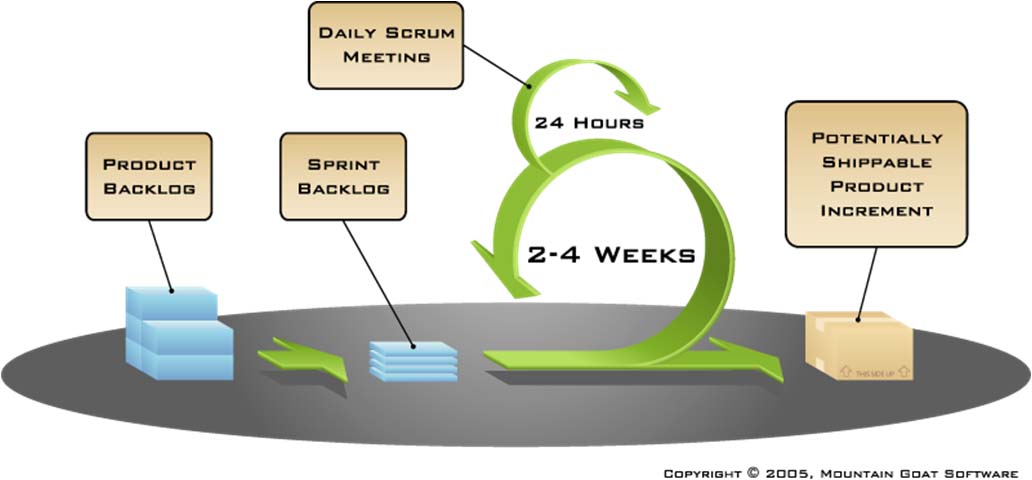
  • We have transparent development: our Product Backlog and Sprint Backlog is hosted (publicly) in JIRA.  We use Greenhopper to plan and track iterations.
  • 3 week iteration.  The product is released almost every iteration!  The Team truly produces a potentially shippable product increment most iterations.
Of course, like every Agile team, we have our share of challenges.  Some of the challenges we experience include:
  • Dealing with unplanned customer support issues as well as pre- and post-sales assistance.
  • Dealing with technical debt.
  • Story sizing: specifically defining small enough slices of potentially shippable functionality.
  • Scaling the team: we're growing fast!
We've adopting Scrum to help us meet these challenges. I'm a firm believer in Agile software development, specifically an Inspect and Adapt framework like Scrum.  Because we're a start-up with a product smack in the middle of a rapidly growing, and evolving, Big Data market, product requirements can change often, sometimes daily. Scrum provides us the framework to adapt to changing business conditions while still regularly producing business value.

It's great being back on the front line of Agility. I hope to find time to blog about these challenges as well as other topics in the coming months, time permitting.


Tuesday, August 9, 2011

Why Agile?


We’re at what I perceive to be a major “transition point” in our Agile transformation.  Most of our Agile pilot teams and projects have successfully completed and we are rolling out internal Scrum training throughout the Product Group.  We’re on the cusp of taking a big step forward with Scrum adoption within our 500 person organization.  It’s at transition points like this when I find myself reevaluating our direction: “Why are we doing this? Are we ready for this next big step?”   Our existing processes do, in fact, lead to shipping product and generating revenue, so: “Why Agile?”

Our original goal, defined we began this transformation, still rings true:

The goal is not to release things faster for the sake of it. It is to achieve nimbleness and agility to deliver on the company’s strategy as it moves forward and/or tactically changes.   It is about creating more business opportunities for ourselves rather than being cased into a model that requires our resource commitment for a time window that is longer than what the market we’re competing in requires.

Specifically, the software development group’s reason for moving from Waterfall to Agile is to achieve nimbleness and agility to deliver on the company’s strategy as it moves forward and/or tactically changes.  We want the ability to efficiently deliver strategic products to market in a timely manner.

Today we have challenges delivering on this goal.  As a mature software organizations our development practices have been hardened over many years of delivering software to tens of thousands of customers.   Our processes have been tempered with the successes (and often, the failures) of the past.    Because of this, it’s difficult to change the current way of doing things.  This is an understandable, and completely human, reaction - but it can dangerous over the long-term.  Fortifying the walls, via policies and procedures as well as organizational divisions, has the result of business being less reactive to change, less agile, which ultimately impacts corporate revenue.   New software releases often take longer to get out the door and may not fully meet customer needs.  Entering new markets in a timely manner becomes difficult, allowing younger more nimble companies a market advantage.   It is for these reasons that we’ve embarked on our development process transformation.

As part of our migration from Waterfall to Agile software development, we need to build a new way of working, including a new corporate culture: one that is nimble and responsive to ever changing business conditions. A culture that values responding to change over following a plan.  One that regularly inspects and adapts, and becomes better over time.  Scrum, with its “inspect and adapt” framework,  is one of the catalysts that can greatly assist us in this journey.

Wednesday, June 8, 2011

Inspect and Adapt


“SCRUM assumes that the systems development process is an unpredictable, complicated process that can only be roughly described as an overall progression.”
-Ken Schwaber, Scrum Development Process, 1995

One of the things that I like about Scrum is that its creators defined it knowing that no development process is perfect.  The Scrum Guide does not tell us how to build software, rather, it openly acknowledges that building software is complicated and unpredictable.  This may seem odd, with Scrum being thought of as a development process (it’s not).  In a recent post to the Yahoo! Scrum Development group, Ken Schwaber stated that “we purposefully constructed Scrum with a lot of holes in which a person or team or organization has to continually figure out the best thing to do.”

So how does a Scrum team “continually figure out” how to do the best thing?   To facilitate iterative and ongoing improvement, Scrum specifies that each Scrum Team hold a Sprint Retrospectives. Further, these retrospectives must happen frequently, occurring immediately following each Sprint Review.  

It is often overlooked when starting out with Scrum, but I believe the Sprint Retrospective is the most important meetings a Scrum team participates in.  While the Sprint Review is a valuable “public” meeting where working product is demonstrated to stakeholders and customers, the Sprint Retrospective is a “private” team meeting, allowing the team to safely discuss what’s working and want could be improved with regards to how they are delivering their work.  In the Sprint Retrospective, anything that relates to how the team operates can be discussed and possibly tuned or improved.  Up for debate could be how the team communicates, technology issues, done-ness criteria, or even choice of tools, as was recently discussed for one of our new Scrum teams in my organization (They reverted back to whiteboard task charts and spreadsheet burndown charts!).

What this ultimately means is that each Scrum team is evaluating, refining, and improving how they work together and build software every 2 to 4 weeks.  Almost continuously improving throughout the life of the project!  Over a 12 month project there can be upwards of 24 opportunities to “do things better” and improve how the software is built and delivered.   Compare that to our our Waterfall-like development model where we generally conduct formal retrospectives twice, once after Beta and once after we release.   In our current model, we, at best, have one predefined opportunity to improve our practices during the release, at Beta when there is usually no more than 3-4 months of (QA and bug fixing time) time remaining before the software is released.  Process improvement is clearly not highly integrated into our Waterfall process.

With frequent inspection and adaptation we can become more efficient at building and delivering high quality software that meets or even exceeds customer expectation.  So my advice is: take full advantage of your Sprint Retrospectives.   As a Scrum team member, it’s your (frequent!) opportunity to make a difference...

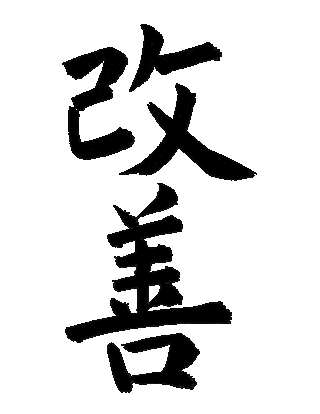
kaizen  (kaɪˈzɛn) - n  a philosophy of continuous improvement 
of working practices that underlies total quality management 
and just-in-time business techniques [Dictionary.com]